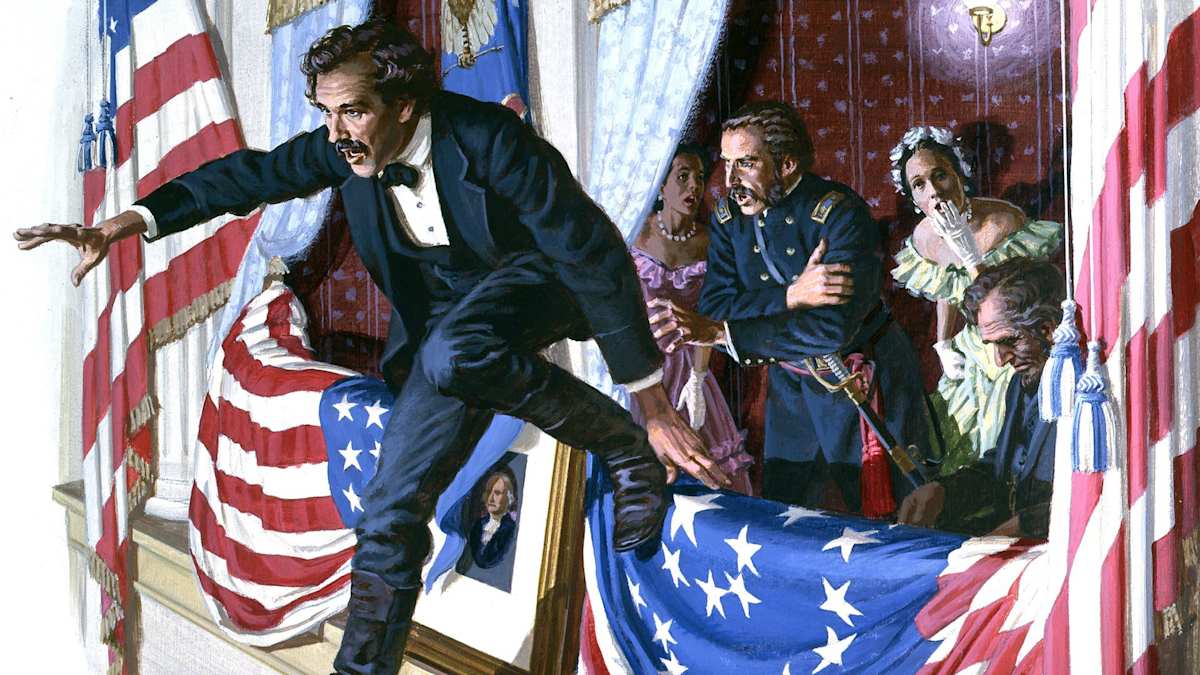
My theme is ‘Learn from History or you are doomed to repeat it’ and my latest book was sparked by my personal experiences of living in the USA and the increasing violence we are seeing in American politics today that, I think can trace its origins back in time. My latest book in the Major Gask Mysteries series, the Case of the Hydegild Sacrifice, explores the dark secrets and atmosphere surrounding perhaps the most notable manifestation of this culture; the assassination of Abraham Lincoln in 1865.
The undercurrent of violence in American politics is not a new phenomenon. Its roots stretch back to the very foundation of the republic – indeed reading about the War of Independence, it’s hard not to conclude that the Civil War almost 100 years later was inevitable given the cultural and economic tensions. The 19th century, in particular, was a crucible where the simmering tensions of a young nation could boil over into deadly acts, most notably the assassinations of its leaders.
Duels, brawls, and fiery rhetoric were common. The infamous duel between Alexander Hamilton and Aaron Burr in 1804, resulting in Hamilton's death, is a stark reminder of how personal and deadly political rivalries could become. The issue of slavery further exacerbated these tensions, creating a chasm that eventually led to civil war.
The violence wasn't confined to battlefields; it permeated legislative halls and public discourse. The amazing caning of Senator Charles Sumner by Representative Preston Brooks on the floor of the Senate in 1856 is inconceivable today but stands as a brutal illustration of the physical violence that erupted from the political disagreements of that era.
It was in this volatile atmosphere that the first presidential assassination occurred. Abraham Lincoln, having guided the nation through its most divisive conflict, was shot by John Wilkes Booth in April 1865. While the assassin was a Confederate sympathizer, my investigations and those of others point to a more complex underlying conspiracy.
Less than two decades later, in 1881, James A. Garfield, a Republican president, was assassinated by Charles Guiteau, a disgruntled office-seeker. While his motivations were arguably more personal than ideological, the act was nonetheless yet another violent assault on the political system.
The century closed with another presidential assassination in 1901. William McKinley, a popular Republican president, was shot by Leon Czolgosz, an anarchist who believed McKinley was a symbol of oppression.
These assassinations were not isolated incidents but rather extreme manifestations of a broader culture of political violence that festered throughout the 19th century. They reflected a society grappling with immense change, profound disagreements, and a brutal willingness to resort to force to achieve political ends, all fuelled by the easy availability of guns and the culture in America that perhaps has its genesis in the heroic Minute-men of the War of Independence.
Understanding this history is crucial to comprehending the long and often fraught relationship between violence and politics in America, a legacy that continues to echo in contemporary debates and divisions and seems to be increasing in intensity.
Here are 10 books that explore these themes and times:
-
The Lincoln Conspiracy: The Secret Plot to Kill America's 16th President—and Why It Failed by Brad Meltzer and Josh Mensch. Though often categorized as non-fiction, this reads like a historical thriller detailing the failed 1861 plot to assassinate President-elect Lincoln in Baltimore.
-
Fates and Traitors by Jennifer Chiaverini. Told from the perspective of the four women closest to John Wilkes Booth, who was a charismatic and famous actor of the time. The novel explores his life and the conspiracy through their eyes, describing the betrayal they felt as his political passions turned deadly.
-
Cold Mountain by Charles Frazier. Set during the final days of the Civil War, a wounded Confederate soldier deserts and makes a perilous journey home. The story details the widespread lawlessness, conscription violence, and political chaos that consumed the Southern home front.
-
The Confession of a Union Spy by P. G. Nagle. Set during the politically charged and often violent Reconstruction era following Lincoln’s assassination, it features a Union veteran turned private detective who travels south and portrays the bitter resistance and violence used by former Confederates to obstruct federal authority and black rights.
-
The Lincoln Deception by David O. Stewart. Set in the wake of the Lincoln assassination, this mystery follows a former Union Army major who is drawn into investigating the missing pages of Booth's diary. It is a thrilling post-Civil War adventure to uncover the full extent of the conspiracy and corruption.
-
The Impeachment of Abraham Lincoln by Stephen L. Carter. An alternate history political thriller where Lincoln survives the assassination attempt but two years later faces an impeachment trial amid a fractured country. A black female lawyer must defend the President, facing political enemies and dark conspiracies.
-
Murder in the Lincoln White House (A Lincoln's White House Mystery #1) by Colleen Gleason. This novel is the first in a historical mystery series featuring a private detective engaged by President Lincoln to solve a murder at the inaugural ball, laying bare the political rivalries and secret agendas rife within the capital.
-
Woe to Live On by Daniel Woodrell. The story of a young man caught up in the violent, politically charged world of the Missouri-Kansas border skirmishes during the Civil War, specifically the Confederate guerillas known as "bushwhackers." It is a dark, brutal adventure story of loyalty, betrayal, and lawlessness.
-
The Good Lord Bird by James McBride. Something lighter - a sometimes humorous adventure told from the perspective of an enslaved boy who is mistaken for a girl and joins the abolitionist John Brown's violent crusade. It also provides a unique, politically charged view of the 1859 raid on Harpers Ferry.
- Pudd'nhead Wilson by Mark Twain. A complex mystery and social commentary set in the antebellum South where a small-town lawyer uses the cutting-edge science of fingerprinting to solve a murder. It explores the violent consequences of slavery and the political underpinnings.