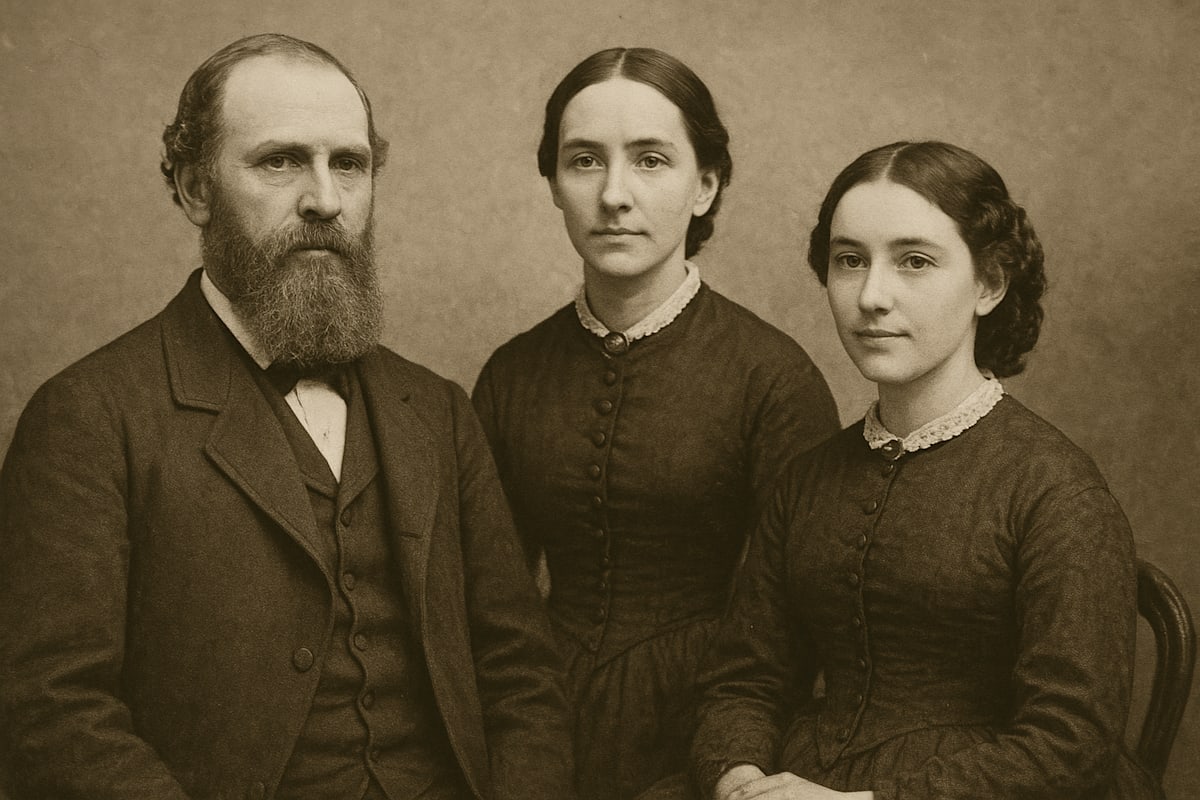
In my research for The Case of the Hydegild Sacrifice, the latest in my Major Gask Mysteries, I found an unexpected link to the legendary Pinkerton National Detective Agency. Few names in American detective history carry as much mystique as Allan Pinkerton and his remarkable operatives. The man who founded the agency in the mid-19th century was a Scot by birth, like my Major Gask character, an abolitionist by principle, and a relentless seeker of truth. Yet Pinkerton’s legacy is shared with two extraordinary women—Kate Warne and Hattie Lewis—whose courage and intelligence helped redefine what women could achieve in a male-dominated profession.
Their intertwined stories—half history, half legend—form the backbone of an emerging genre that explores not only the birth of modern detective work but also the complexities of gender, loyalty, and morality in America’s Gilded Age.
The Making of a Detective Empire
Allan Pinkerton’s story begins far from Civil War intrigue. Born in Glasgow in 1819, he emigrated to the United States in 1842 seeking opportunity and freedom. Working as a cooper in Illinois, he stumbled upon a counterfeiters’ hideout—a discovery that launched his first investigation. By 1850, he had founded the Pinkerton National Detective Agency, adopting the motto “We Never Sleep” beneath the now-famous unblinking eye logo.
Pinkerton’s agency grew rapidly, serving railroads and major corporations, hunting train robbers and counterfeiters, and later infiltrating labour movements. Before its darker corporate phase, however, Pinkerton’s detectives served an almost romantic ideal of justice. His agency famously foiled the first known attempt to assassinate President-elect Abraham Lincoln in 1861—an operation that brought to prominence the most remarkable woman in his ranks, Kate Warne.
Kate Warne: The First Lady of Detection
When Kate Warne entered Pinkerton’s Chicago office in 1856 seeking work as a detective, he assumed she wanted secretarial duties. Warne, recently widowed, argued that a woman could achieve what no man could—win the confidence of other women, enter domestic spaces, and extract information closed to male investigators. Pinkerton, impressed by her audacity, hired her. It was revolutionary: Warne became the first female detective in the United States, and quite possibly the world.
She soon proved indispensable. Disguised as a Southern belle or a society widow, Warne infiltrated criminal circles, gathered intelligence, and played a central role in uncovering the Baltimore Plot, a conspiracy to assassinate Lincoln en route to his inauguration. Disguised as his invalid sister, she personally escorted him through hostile territory to Washington. Lincoln’s survival changed history; Warne’s daring changed what was possible for women in intelligence work.
In Pinkerton’s own florid detective memoirs, Warne appears as both idealized heroine and consummate professional. She later headed Pinkerton’s Female Detective Bureau, trained other women—including Hattie Lewis—and led operations demanding intellect and courage. Her early death at thirty-five in 1868 cut short a brilliant career, but Pinkerton ensured her place in the agency’s lore.
Hattie Lewis: In the Shadow of Legends
Less well known but equally intriguing is Hattie Lewis, one of Warne’s protégées who carried the torch of female detection into the post-war years. Described as intelligent, attractive, and brave, she fascinated Major Gask from the moment they meet in Hydegild, crossing the Atlantic aboard the Scotia. Soon she is working with Gask and Errol Rait to forestall yet another plot against Lincoln.
Historical details about Lewis are fragmentary—her life survives mainly in Pinkerton’s publications and agency archives—but her career shows how his radical experiment with women detectives matured into a professional model. Like Warne, Lewis relied on disguise, charm, and psychological insight. Where Warne’s missions were dramatic, Lewis’s were meticulous, reflecting the shift from the romantic adventures of the Civil War to the pragmatic realism of the Gilded Age.
Lewis and her colleagues—sometimes called the Lady Pinks—helped transform Pinkerton’s agency into something resembling a modern intelligence organisation. Recent historians and novelists have begun reclaiming her from obscurity. In fiction, she appears as Warne’s loyal yet self-aware apprentice; in history, as an early example of women’s increasing visibility in professional life. Her story raises an enduring question: how many Kate Warnes and Hattie Lewises have vanished from history’s ledgers, their achievements hidden behind a patriarch’s name?
Pinkerton’s Legacy and the Literature It Inspired
Modern readers meeting these figures on the page are struck by how cinematic their lives seem. Pinkerton himself blurred the line between fact and fiction. His detective books, written from the 1860s onward, turned real cases into sensational narratives, effectively inventing the American detective genre before Sherlock Holmes ever stalked the gaslit streets of London.
Contemporary authors, including myself, have rediscovered Pinkerton, Warne, and Lewis as fertile subjects for historical fiction. Their lives offer not only adventure but insight into the evolution of identity, ethics, and gender. The Pinkerton saga invites readers to confront a moral paradox: these agents were champions of justice whose methods—surveillance, infiltration, manipulation—anticipated the rise of private intelligence and corporate policing.
Writers portray Pinkerton as both visionary and authoritarian; Warne as both liberated and constrained by her era’s expectations; Lewis as a professional navigating secrecy, loyalty, and the slow recognition of women’s intellect. Together they mirror 19th-century America—its promise, prejudice, and restless drive for reinvention.
A Legacy Reconsidered
Today, the Pinkerton name endures—sometimes controversially—as shorthand for private security and corporate investigation. Yet behind that unblinking eye logo stand the pioneers who gave the agency its conscience. Pinkerton’s dedication to order, Warne’s courage, and Lewis’s perseverance each reflect a turbulent century’s struggle to define justice.
In our own age of espionage thrillers and forensic dramas, revisiting these 19th-century detectives reminds us that the origins of the profession were personal and improvised. They were not superheroes but individuals of conscience and ambition, negotiating a society in transition. Their stories—half hidden, half celebrated—ask how justice, loyalty, and courage are defined in every generation.
If The Case of the Hydegild Sacrifice achieves anything, I hope it helps return to the stage those who once worked unseen - watching, listening, daring to act when few others could. Allan Pinkerton, Kate Warne, and Hattie Lewis are not relics of the past but prototypes of the modern detective—guardians who never sleep. And alongside them, my fictional investigators Major Gask and Errol Rait take their place in that long tradition of watchfulness, courage, and sacrifice.