Let me be clear: I am conflicted. I shed no tears for the death of Iran’s leadership – they and it were despicable monsters shielding, like so many before them, monstrous acts behind a wall of religious ideology. The world is a better place with them gone.
However, as I read recently: opposing a sinner makes you an opponent, not a saint and what comes next, in my humble opinion, is likely to be worse than what went before because Trump and his ‘advisors’ had no idea how this would play out other than providing them with a lot of exquisite explosions on their video terminals and deaths – just like playing games on their playstation. But real.
Trump created the opportunity to go to war by cancelling the Iranian nuclear accords already in place. He then went to war proclaiming ‘Rise up, Iranians’ without having done the hard yards of enabling a viable opposition to do just that. Consequently, I believe we shall see a harder version of the same regime take over and endless terrorist action impacting the Middle East and the West for a long time to come.
Consequences
If the world can tolerate acts by the strong against the weak, who knows where it will end?
If ‘might is right’, we ignore Russia’s invasions, we ignore a Chinese assault on Taiwan, we ignore actions of the Red Guard and the IRGC (and ICE, too), we ignore any pretence of moral judgment or justification anywhere. The UN is dead and buried. Peace in our time is just an empty slogan worth as much as Chamberlain’s bit of Munich paper.
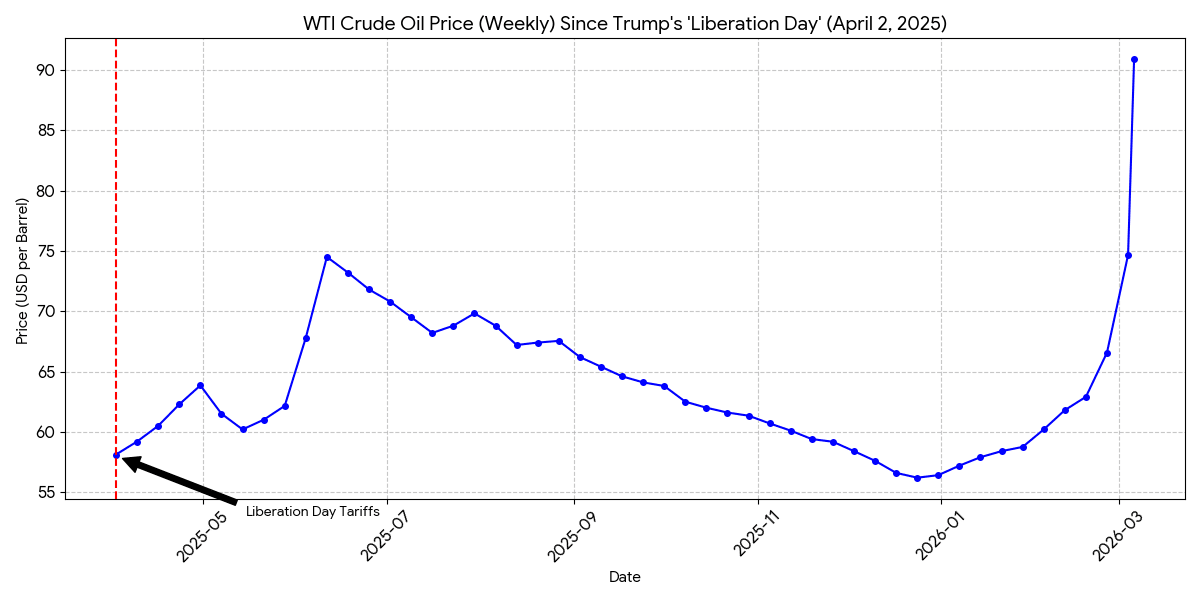
We are already seeing the consequences of Trump’s impetuous actions play out. Hundreds of children dead in a US bombing of a school, American soldiers dead and wounded. Bloodied and dead civilians who were unable to outrun the keyboard warriors. The Straits of Hormuz are blocked and oil prices have risen 60% since he held up his board to proclaim ‘Liberation Day’ tariffs. War is enveloping the Middle East, Civilians and soldiers are dying. And the man who faked a disability to avoid the draft plays at War Dictator with his eager accomplice, Netanyahu.
He has a taste for it. Watch Cuba – that’s next.
As WTI crude oil flirts with $93 per barrel this Sunday morning, the initial "shock and awe" of the U.S. strike on Iran has transitioned into a cold, clinical realisation for global markets: we aren't looking at a temporary spike. We are looking at a structural reconfiguration of the global economy.
When you remove the free passage of the Strait of Hormuz — the artery for 20% of the world's petroleum—you don't just raise the price of a gallon of gas. You initiate a slow-motion collapse of the post-2022 recovery.
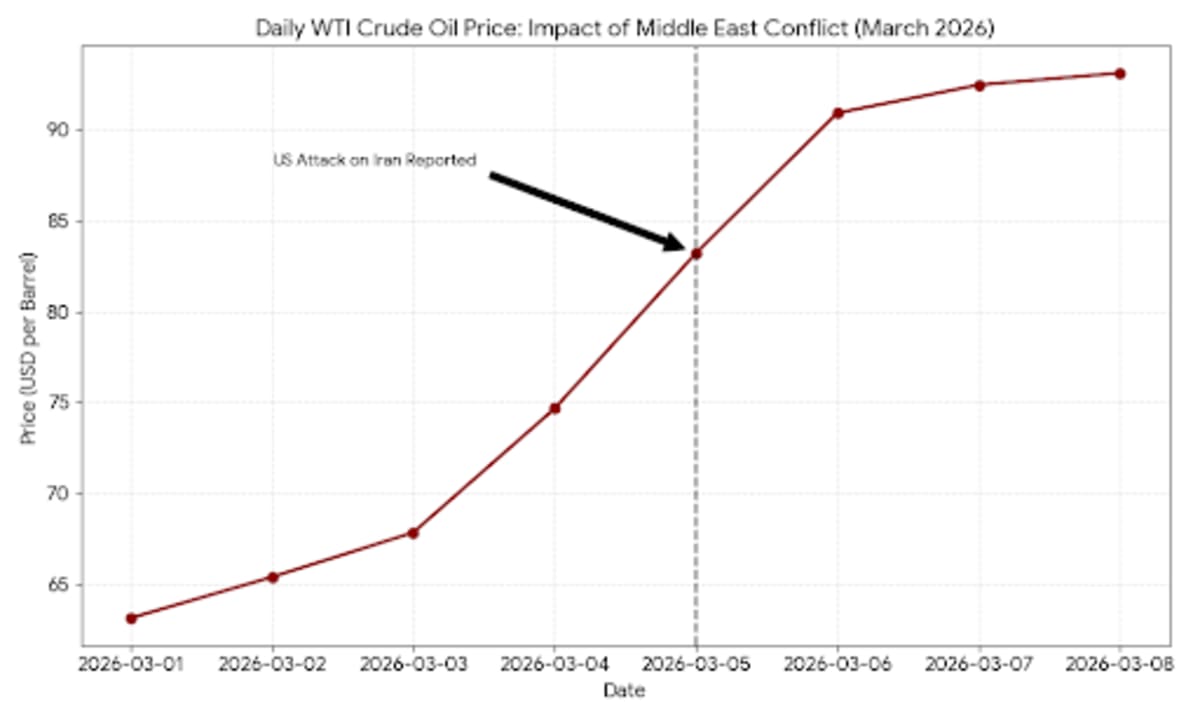
The rising lines on my oil charts are not just a price — they are a countdown. If the Strait of Hormuz remains closed for more than 14 days, we move from a "market correction" to a "global contraction." Australia may have the minerals, and Europe may have the industry, but neither can survive a world where the primary energy artery is severed by a leader who values "exquisite explosions" over economic equilibrium.
Below are a series of Global Stability Metrics designed to track the "permanent tax" this conflict is levying on the Australian and European markets.
Metric 1: The Energy-Equity Divergence (ASX vs. Euro Stoxx)
The divergence between Australia and Europe reveals the different "flavours" of pain this conflict provides.
- The European "Energy Tax" (Euro Stoxx 50):
For Europe, $90+ oil is a direct hit to the industrial heartland. Strategists at Barclays are already forecasting a 10% downside for the Stoxx 600 if the conflict pushes Brent toward $100. Without domestic reserves to buffer the shock, the European recovery is effectively "on ice." - The Australian "Commodity Paradox" (ASX 200):
While energy giants like Woodside and Santos are seeing green on their screens, the broader ASX 200 is reeling. The market has snapped a three-week winning streak as the "inflation ghost" returns, forcing the RBA to keep its hawkish stance. Australia is shielded by its resources but strangled by its interest rates.
Metric 2: Sovereign Resilience Index (The Currency War)
In times of energy war, currencies becomes the primary victim of "geopolitical arson."
USD/AUD | Strengthening (0.69 - 0.70) | The Greenback remains the ultimate "safe-haven" despite being the aggressor. The AUD, normally a commodity play, is being sold off as global "risk-off" sentiment overrides iron ore gains.
EUR/USD | Downside Bias (1.04 - 1.06) | Europe's reliance on imported energy makes the Euro a proxy for the conflict's duration. Every dollar oil gains is a cent the Euro loses.
CAD/USD | Outperforming | Canada, the "other" North American energy powerhouse, is the sole winner, benefiting from the very tariffs and conflict that are burning everyone else.
Metric 3: The Logistics & Insurance "Friction" Coefficient
The physical bottleneck at the Strait of Hormuz has created a "phantom supply chain." Even oil that isn't from the Middle East is now more expensive to move.
- VLCC Charter Rates: The cost of a Very Large Crude Carrier has skyrocketed from $120,000 to over $420,000 per day in a single week.
- The Insurance Freeze: Most global insurers have suspended coverage for any hull entering the Persian Gulf. This "de-facto blockade" means that even if a tanker makes it through, it does so without a safety net, adding a "war premium" that will soon appear on grocery shelves from Brisbane to Berlin.
Metric 4: The Rule of Law Erosion Score
This is the most dangerous, yet least talked about metric. By bypassing the UN and moving straight to "kinetic solutions," the Trump administration has signalled that the rules of 1945 are over.
- Stability Rating: Critical: Markets hate unpredictability. When "Stability" is replaced by the whims of a single leader’s "Playstation" strategy, capital flees long-term infrastructure and hides in short-term gold and defensive bonds.
The Bottom Line
The big winners here – if there is such a thing – are China and Russia. The loser is the USA and most everyone else. Watch Taiwan now China has a ‘Get out of Jail Free’ card. The war in Ukraine will keep festering – a bloody stalemate costing thousands of lives. The global economy will stutter and begin selectively failing. US involvement in another ‘forever’ war has begun (but the Nobel Peace prize!).
The rising lines on my oil charts are not just a price — they are a countdown. If the Strait of Hormuz remains closed for more than 14 days, we move from a "market correction" to a "global contraction." Australia may have the minerals, and Europe may have the industry, but neither can survive a world where the primary energy artery is severed by a man who values "exquisite explosions" over economic equilibrium.
Come November, we are likely to see Congress change dynamics and begin to constrain this warmonger to a degree.
But that’s a long way away. Tighten your seat belts.